October 2023: Introduction of Two New Systems in Japan - (1) Tightened Importer Definitions (2) QIS: Japan Consumption Tax's Qualified Invoice System
 SK ADVISORY INC
For Foreign Corporations Without a Base in Japan:
We are informing you about the two new systems that commenced in October 2023. These systems are distinct and must be approached separately. However, there are aspects where they intersect and must be understood collectively. Here's a detailed breakdown:
Japan Customs has clarified the definitions of Importers, necessitating the shift from using IOR Providers to ACP (Attorney for Customs Procedures) in numerous instances
Since October 2023, Japan Customs mandated that foreign corporations (non-residents) without a presence in Japan must act as importers themselves in many situations. Utilizing another company to serve nominally as the importer, such as an IOR service provider, will no longer be an option.
To comply with these regulations, foreign corporations lacking a Japanese base need to appoint an ACP (Attorney for Customs Procedures), making the ACP system essential for their operations.
Why this System Change?
There have been instances where foreign corporations, along with importing agents unfamiliar with customs laws or lacking proper compliance awareness, have collaborated. Such collaborations often result in the failure to accurately pay the necessary duties and consumption taxes upon importation by utilizing undervalued invoices, almost simulating a sales transaction. To address this issue, Japan Customs now instructs foreign corporations to engage with ACP. Using ACP mandates that commercial distribution transaction details be presented to the customs office, ensuring the declaration of an appropriate import value.
Typically, the import declaration value is derived by subtracting certain domestic costs from the projected domestic sales price, in line with the Japanese Customs Tariff Law. However, we believe there's no significant cause for concern regarding this value. Japan's tariff rate is relatively low on an international scale, and the import consumption tax is primarily a "tax borne by the end consumer". Though a 10% consumption tax is required at the point of import, it can be recouped from customers during sales. If a tax return is accurately filed, any overpayments will be refunded.
Moreover, to claim credits for the consumption tax on purchases (paid upon importation), the seller—a foreign corporation—must assume the role of an importer. Alongside appointing an ACP, foreign entities should also designate a tax accountant to act as a tax agent. This ensures the accurate filing of consumption tax returns with the tax office.
As seasoned ACP professionals, we lead consultations with Japan Customs proactively to guarantee seamless import customs clearance and oversee the determination of import declaration values, among other critical aspects. Our expertise extends to countless import/export projects, and we pride ourselves on a flawless record of customs clearance.
Related Readings:


Qualified Invoice System (QIS) for Japan Consumption Tax (JCT)
The forthcoming alteration pertains to the national tax system.
The advent of the consumption tax invoice system means a surge in overseas companies becoming consumption tax invoice issuers. For a Japanese customer (buyer), during consumption tax return filing, the invoice must be issued by a registered invoice-issuing entity. Otherwise the Japanese customer cannot claim the purchase tax credit on the consumption tax paid to a seller.

Once Company-A obtains a JCT invoice registration number, it becomes a taxable entity required to file JCT returns regularly.
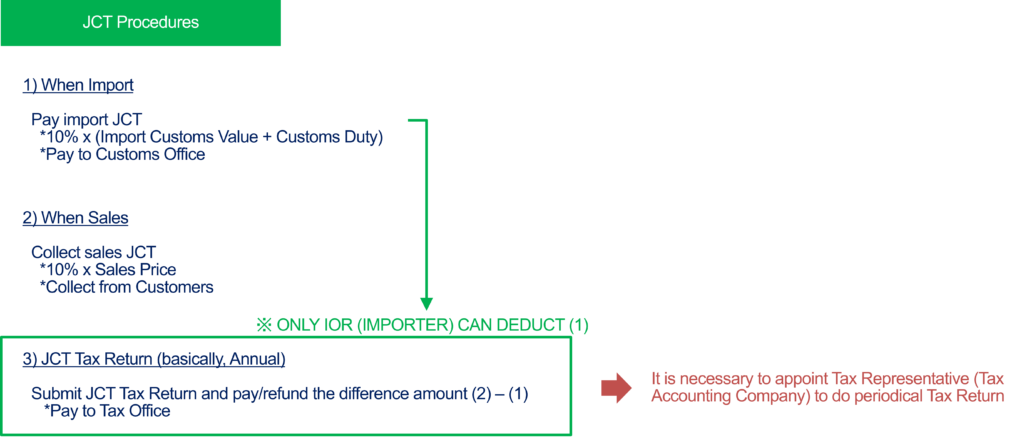
For non-resident entities (Company-A) importing and selling in Japan, the standard procedure involves three steps:
- Pay import JCT to customs: 10% of the import customs value.
- Collect JCT from customers in Japan: 10% of the sales price.
- File a JCT tax return and pay the net JCT to the tax office.
If Company-A paid the import JCT as the importer using an Attorney for Customs Procedures (ACP), they need only pay the net amount of sales JCT minus import JCT.
If Company-A paid the import JCT but was not the importer, they must pay all the collected sales JCT without deducting the import JCT.
Therefore, using an ACP to act as the Importer of Record (IOR) is crucial for managing JCT deductions and refunds. If another company acts as the IOR, you cannot deduct the import JCT, resulting in significant costs.
We strongly recommend using our ACP services to ensure you can act as IOR, optimizing your JCT handling. Our team has extensive experience helping clients become importers and successfully manage their JCT responsibilities. You can rely on our expertise to navigate these complexities.
Related Readings:
What Is a JCT Tax Representative and Why Is It Required?
When a non-resident foreign entity becomes subject to Japan’s Consumption Tax (JCT), it is required to appoint a JCT Tax Representative (Tax Agent).
If a non-resident company sells goods to customers in Japan, it typically collects 10% consumption tax on those sales. This collected JCT must be reported and submitted to the Japanese National Tax Office, unless the entity qualifies as a tax-exempt business. (See: "Are we a Tax-Exempt Business?")
If the entity is JCT-liable—or voluntarily registers as a taxable entity, such as by obtaining a Qualified Invoice Issuer Number—it must appoint a JCT Tax Representative to handle all tax-related procedures in Japan, including JCT tax filings.
In the JCT tax return process, the paid import JCT can be offset against the collected JCT.
- If the import JCT exceeds the collected amount, the difference may be refunded.
- If the collected JCT exceeds the import amount, the difference must be paid to the tax office.
A JCT Tax Representative is legally required to manage this process on behalf of the foreign entity.
Please note:
The JCT Tax Representative is distinct from the Attorney for Customs Procedures (ACP), which is appointed for customs clearance purposes.
- ACP = Customs representative
- JCT Tax Representative = Tax representative
Our Japan Consumption Tax (JCT) Representative Services
At SK Advisory Inc., we provide a comprehensive one-stop service that covers both customs procedures through the Attorney for Customs Procedures (ACP) and Japan Consumption Tax (JCT) procedures with the National Tax Agency through a designated JCT Tax Representative.
By working closely with our trusted partner tax accountants, we act as your ACP while maintaining close coordination and information sharing with the tax representative. This collaboration ensures the proper deduction and refund of Japan Consumption Tax paid at the time of importation.
Please Be Aware
- In cases where foreign corporations (non-residents) without an office in Japan import or export goods, failure to properly prepare an Importer of Record (IOR) or Exporter of Record (EOR) through an Attorney for Customs Procedures (ACP) or similar means can result in goods being held at customs, leading to significant delays and costs. To avoid such risks, please make thorough preparations.
- If an ACP is needed, it is crucial to utilize the services of an experienced ACP well-versed in customs-related laws and regulations. The import and export operations of non-residents/foreign corporations using an ACP are treated as unique cases. Many customs brokers are not familiar with these procedures, leading to incidents where goods are detained for extended periods due to unsuccessful explanations to customs. (Customs will not permit the import if the explanations provided by the importer or customs broker are unsatisfactory, resulting in the goods being detained until customs is convinced.)
- We highly recommend utilizing our services as professional experts in customs, knowledgeable about customs-related laws and regulations. With a proven track record of resolving numerous issues through direct consultations with customs officers and customs brokers, our clients supported as an ACP now exceed 200 companies. We are committed to delivering industry-leading results with our expertise.
Why choose us?
We specialize in navigating complex issues at the intersection of customs procedures and taxation—an area where our ability to offer practical, comprehensive support from both perspectives sets us apart. Understanding the close relationship between customs duties and national taxes (especially, Japan Consumption Tax - JCT), and addressing both in an integrated manner, is crucial in the context of international trade.
- Customs and International Trade Professionals - Led by our CEO, Mr. Sawada—Certified Customs Specialist and former KPMG professional—SK Advisory provides expert-level support in Customs and international trade. Mr. Sawada also serves as an external expert for the World Bank’s B-READY project in the field of customs and international trade.
- Full Compliance with Japanese Customs Law - We ensure full adherence to Japanese Customs Law, including Importer of Record (IOR) structure, HS code classification, and customs valuation. We assist in preparing all essential shipping documents for non-resident entities.
- One-Stop Support for ACP and JCT Tax Representative Services - In collaboration with trusted partner tax accountants, we provide comprehensive support for both customs procedures through the Attorney for Customs Procedures (ACP) and Japan Consumption Tax (JCT) filings through the JCT Tax Representative.
- Multilingual Communication - Our team communicates fluently in English, Japanese, and Chinese, offering smooth coordination with global clients and authorities in Japan.
- Support for Regulated Products - Our ACP/IOR partnership system can manage regulated items, including cosmetics, PSE-products, foodstuffs, and tableware.
- Trusted by Global Clients - Serving around 100 ACP clients annually, including many Amazon sellers, we’re a certified provider on Amazon SPN (Service Provider Network) under Trade Compliance.

Track Record – Attorney for Customs Procedures (ACP) Services
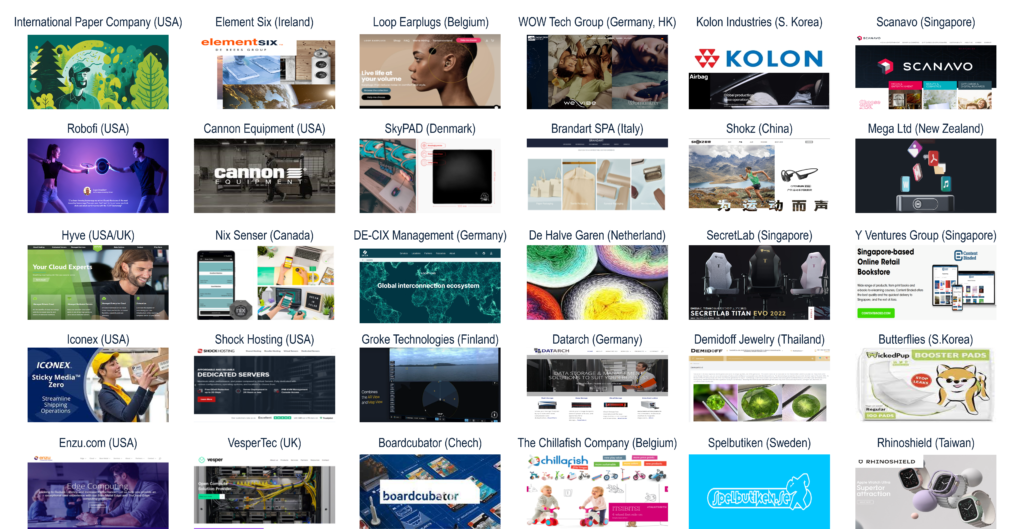
We have supported import and export operations in Japan for over 200 clients across more than 40 countries.
Examples of International Logistics Partners We Have Worked With
We have a proven track record of working with a wide range of logistics providers. As the Attorney for Customs Procedures (ACP), we handle customs-related responsibilities while logistics companies manage transportation and warehousing operations.
- American Overseas Transport (AOT)
- Apex International
- Brink's
- CEVA Logistics
- Coshipper
- Crane Worldwide Logistics
- DB Schenker
- DGX (Dependable Global Express)
- DHL Express
- DHL Global Forwarding
- Dimerco
- DSV Air & Sea
- Expeditors
- FedEx Express
- FERCAM
- GOTO KAISOTEN Ltd.
- Harumigumi
- Herport
- ICL Logistics
- JAS Forwarding
- Kintetsu Express
- Kokusai Express
- Kuehne + Nagel
- Mitsubishi Logistics
- MOL Logistics
- Nankai Express
- Nippon Express
- OIA Global
- PGS
- Rhenus Group
- Röhlig
- Sankyu
- Sanyo Logistics
- Scan Global Logistics
- Seino Schenker
- SEKO Logistics
- Shibusawa Logistics Corporation
- Shin-Ei gumi
- Shiproad
- Sumitomo Warehouse
- UPS
- UPS Supply Chain Solutions
- Yamato Transport
...and many other logistics providers in Japan and around the world.
Our ACP Service: The Best Solution for the Japan Importer of Record (IOR) and Exporter of Record (EOR)
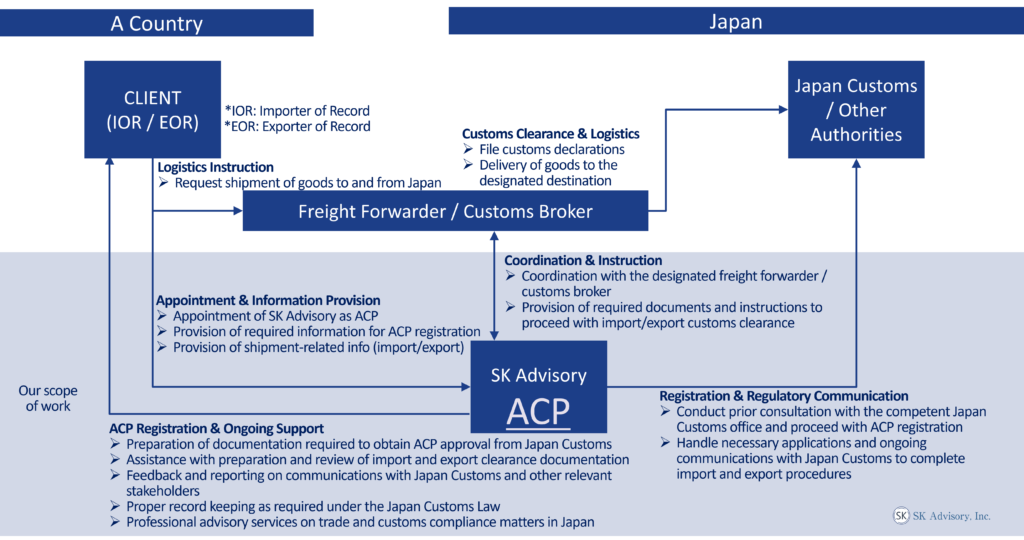
ACP is an effective solution for addressing Importer of Record (IOR) and Exporter of Record (EOR) requirements in Japan. Through our ACP service, non-resident entities located outside Japan are able to import and export goods as Non-Resident IOR and EOR.
Below is an overview of our basic scope of work, together with a diagram illustrating the operational structure of the ACP service. Once ACP registration is completed, the non-resident entity can act as the Importer of Record (IOR) and Exporter of Record (EOR) in Japan.
Scope of Work – How We Can Assist
- Preparation and filing of all required documents for ACP registration with Japan Customs.
- Coordination and communication with relevant stakeholders, including Japan Customs, logistics providers, and customs brokers to ensure the smooth and compliant import and export procedures.
- Preparation and review of import documentation, including commercial invoices and shipping documents.
*Proper customs clearance requires accurate identification and statement of the shipper, consignee / Exporter of Record (EOR), and Importer of Record (IOR) on B/L, AWB, and Commercial Invoice. We provide practical guidance on correct documentation practices. We also advise on customs valuation (import declaration value) and its supporting documentation, HS classification, and country of origin to ensure compliance with Japanese customs requirements. - Advisory on customs valuation (import declaration value), HS codes, duty rates, and origin (including advance rulings).
- Import compliance support for regulated products, including Domestic Administrator (sometimes referred to as “Domestic Representative”) Services under the Product Safety Acts (PSE/PSC) and food-related products regulated under the Food Sanitation Act.
- Support for security export control, including list-based classification, catch-all control assessment, and assistance with export license applications to the Ministry of Economy, Trade and Industry (METI).
- Maintenance and retention of records required under the Japan Customs Law.
- Provision of professional trade and customs advisory services to address and resolve issues that may arise during import or export operations.
**Both import and export activities can benefit from the use of an ACP (Attorney for Customs Procedures). This support is applicable in scenarios where a non-resident acts as the Importer of Record (IOR) for imports and as the Exporter of Record (EOR) for exports.
Three Steps to Initiate Shipments Under the ACP Program:
- Quotation Review to Contract Conclusion: Upon receiving your contact details, we will promptly provide a quotation for your review.
- Commencing the Registration of ACP (Attorney for Customs Procedures) to Japan Customs: This process is generally completed in about two weeks.
- Initiation of First Shipment, Import/Export