
Customs Valuation: Determining the Import Declaration Value
Primary determination method
The process of determining the Import Declaration Value of imported goods is known as "Customs Valuation." In most cases, when an import is based on an "Import Transaction"※1 between an overseas seller and a buyer in Japan, the primary determination method can be utilized.
※1:An "Import transaction" refers to a transaction where a buyer in Japan engages in a sales transaction with an overseas seller for the purpose of shipping goods to Japan, and the goods subsequently arrive in Japan.
Under the primary determination method, the Customs value of the imported goods is determined as the transaction price paid by the buyer (CIF basis).
Customs Duty is often calculated by multiplying the Customs Value (Transaction Value) by the Duty Rate, which varies depending on the HS code of the goods.
Consumption Tax, on the other hand, is calculated by multiplying the Customs Value plus Customs Duty by the Consumption Tax rate (currently 10%).

Exceptional determination method (e.g. when to use ACP)
In cases where a non-resident company imports goods into Japan without engaging in a sales transaction, the primary method cannot be utilized. Simply using an Invoice Value is not appropriate.
To calculate the Customs Value in such situations, it is necessary to apply the Exceptional Determination Method.
Within the exceptional determination method, several methods can be considered:

- Transaction Value of Identical or Similar Goods Method: If you have previously imported goods that possess identical or similar conditions to the goods in question, the transaction value of those goods can be used.
- Domestic Selling Price Method (Deductive Method): If you can identify the sales price (can be an estimated sales price), the domestic selling price method can be employed.
- Cost of Production Method (Cost plus Method): If the exporter is a manufacturer and can provide production costs, the production cost method may be applicable.
If none of the above methods are suitable, "Other methods" are utilized as a flexible determination method, taking into account the calculation methods mentioned earlier.
In the practical scene, most of the cases we use this “Other methods” which is a determination method in a flexible way through considering the previously mentioned calculation methods.


Avoiding Customs Valuation Problems
In recent times, there have been numerous instances of trouble arising from incorrect Customs Value settings.
In the worst-case scenario, goods may fail to clear customs, resulting in significant detention fees and eventual return shipment.
At SK Advisory, we specialize in establishing appropriate Customs Values. We can assist in conducting consultations with Japan Customs on behalf of our clients, effectively avoiding any potential issues down the line.
For Amazon's FBA business, there is a recommended calculation formula for the declaration value. If you would like to learn more about it, please don't hesitate to contact us!
Please Be Aware
In cases where foreign corporations (non-residents) without an office in Japan import goods, failure to properly prepare an Importer of Record (IOR) through an Attorney for Customs Procedures (ACP) or similar means can result in goods being held at customs, leading to significant delays and costs. To avoid such risks, please make thorough preparations.
If an ACP is needed, it is crucial to utilize the services of an experienced ACP well-versed in customs-related laws and regulations. The import and export operations of non-residents/foreign corporations using an ACP are treated as unique cases. Many customs brokers are not familiar with these procedures, leading to incidents where goods are detained for extended periods due to unsuccessful explanations to customs. (Customs will not permit the import if the explanations provided by the importer or customs broker are unsatisfactory, resulting in the goods being detained until customs is convinced.)
We highly recommend utilizing our services as professional experts in customs, knowledgeable about customs-related laws and regulations. With a proven track record of resolving numerous issues through direct consultations with customs officers and customs brokers, our clients supported as an ACP now exceed 100 companies. We are committed to delivering industry-leading results with our expertise.
Japanese Customs System Reform: Clarification of Importer Definitions
Starting October 1, 2023, Japanese Customs has instituted a pivotal reform aimed at addressing the issue of foreign sellers improperly designating third parties (such as forwarders or customs agents) as importers.
This revision necessitates foreign corporations to utilize an Attorney for Customs Procedures (ACP) to assume the role of Importer of Record (IOR) directly in many cases. The practice of merely nominally appointing another entity as the importer is no longer feasible.
Notably, foreign corporations that act as importers themselves, through the engagement of ACP, are eligible for Japan Consumption Tax (JCT) benefits. (link: Consumption Tax Treatment and Benefits of Using ACP).
As a dedicated ACP firm, we ensure compliance with the law to facilitate correct import procedures, allowing you to trust us with your importation requirements confidently. We are eager to engage in further discussions with you.
Revisions Effective October 1, 2023:
Definition of the Importer
- Regarding a cargo imported under import transaction, an importer is equivalent to “a person who imports a cargo” defined in Article 6-1 (1), General Notification of the Customs Act. ..... This means, the Consignee, etc., in the case of imports conducted through normal transactions between an overseas seller and a Japanese buyer
- In the cases other than above, an importer is a person who has a right to disposition of the import cargo at the time of import declaration. If there is another person who acts on the purpose of the import*, that person is also included :
In case of a cargo imported:
- under lease contracts, a person who rents and uses the cargo.
- for consignment sales, a person who sells the cargo in the name of himself/herself (consignee) by accepting the commission.
- for processing or repairing, a person who processes or repairs the cargo.
- for disposal, a person who disposes the cargo.
For additional information, please refer to the following resources:
- Japan Customs: Leaflet(English) Revision of Import Declaration Items and Attorney for Customs Procedure (ACP) System
- English: Announcement from Japan Customs | Mandatory to Use ACP in Many Cases – Attorney for Customs Procedure
Why choose us?
- Customs and International Trade Professionals - Our CEO, Mr. Sawada, is a Certified Customs Specialist in Japan. With years of experience providing services in the Trade & Customs field, his leadership at KPMG and the establishment of his own company, SK Advisory, ensures our commitment to excellence and high-quality service.
- Full Adherence to Japanese Customs Law - Our top priority is to maintain full compliance with Japanese Customs Law and safely import / export our clients' goods into / from Japan. We meticulously manage all import compliance aspects, including Japan Importer of Record (IOR) matter, HS code classification and the correct Customs Valuation of goods entering Japan. We support to complete all the necessary shipping documents, such as Invoice, Packing List and BL, on behald of non-resident / foreign Japan IOR.
- Communication in English, Chinese, and Japanese - Our team, with extensive international experience, excels in communication in English, including facilitating English-language meetings, and has earned considerable trust from clients. We also have staff capable of communicating in Chinese, making us equipped to handle Chinese-language support as well. Naturally, as a Japan-based team, we're totally fluent in Japanese, ensuring seamless communication across these three key languages.
- Reputable and Reliable Partner -The growing demand for our Attorney for Customs Procedures (ACP) services is testament to our quality. We proudly serve clients globally, registering over 50 ACP customers annually. Our consistent track record underscores our reliability and credibility. For a detailed list of our clientele, please visit our "Experiences" section. Our unwavering commitment ensures all our clients successfully acquire Japan IOR status and import goods seamlessly into Japan.
- Recognized ACP Service Provider on Amazon SPN SPN (Service Provider Network) - We are a certified ACP service provider within Amazon's Service Provider Network (SPN), listed under the Trade Compliance category. Many international Amazon Sellers have successfully become Japan Importers of Record (IOR) through our ACP services.

Our Customers - Japan IOR / Attorney for Customs Procedures (ACP) Service
All our clients have successfully become Japan Importer of Record (IOR) and imported goods into Japan under our guidance.

Logistics Companies with Collaboration Experience
Here is a list of our partner logistics and forwarding companies with whom we have had successful collaborations. Please note that this list is not exhaustive, as we are open to working with any logistics or forwarding companies. As Attorneys for Customs Procedures (ACP), we represent non-resident clients (IOR) and coordinate with these logistics companies, who manage the transportation of goods to and from Japan.

Our ACP service
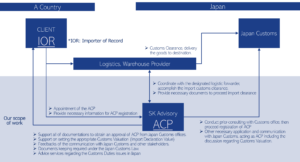
ACP is the best solution for the IOR issue in Japan. Through our ACP service, non-resident entities located outside of Japan can import goods as Non-Resident Importers (Non-Resident IORs).
The following are our basic scope of work and diagram showing the operational structure of the ACP service. Once ACP registration is done, the non-resident entity can be IOR - Importer of Record in Japan.
Basic Scope of Services:
- Consultation with the Japan Customs Office for successful ACP registration.
- Liaising with stakeholders, including Logistics Forwarding Companies and the Customs Offices, on behalf of non-resident clients (i.e., non-resident Japan IOR) to ensure the secure importation of goods.
- Assistance in preparing the necessary documentation for import clearance.
- Support of calculation of Customs Value (Customs Valuation Formula), in accordance with appropriate compliance under the Japan Tariff Customs Law.
- Security Export Control (Classification for List Control, Examination for Catch-All Control, Application of the license to Ministry of Economy, Trade and Industry)
- Documents keeping, required under article 95 - Japan Customs Law
- Providing professional trade/customs advice if any issues arise.
**Both import and export activities can benefit from the use of an ACP (Attorney for Customs Procedures). This support is applicable in scenarios where a non-resident acts as the Importer of Record (IOR) for imports and as the Exporter of Record (EOR) for exports.
Three Steps to Initiate Shipments Under the ACP Program: :
-
Quotation Review to Contract Conclusion: Upon receiving your contact details, we will promptly provide a quotation for your review.
-
Commencing the Registration of ACP (Attorney for Customs Procedure) to Japan Customs: This process is generally completed in about two weeks.
-
Initiation of First Shipment, Import/Export
FAQ for ACP (Attorney for Customs Procedures)
What is the role of ACP (SK Advisory)?
- Representation: ACP (SK Advisory) represents the foreign importer and liaises with Japan Customs and the Forwarding Company/Customs Broker.
- Documentation and Compliance: ACP assists in preparing essential import documents (e.g., Invoices) in compliance with Japan Customs Law and formally requests the Customs Broker to proceed with customs clearance.
- Expert Consultation and Troubleshooting: We are a team of legal experts in Customs Laws, providing direct consultations with Japan Customs to ensure compliance and address issues, including troubleshooting unique challenges in non-resident imports.
How long time does it require to get ACP’s registration?
It will take approximately 2 weeks until getting an approval from Japan Customs Office.
The breakdown of the task is as follows.
- Prepare the necessary documentation between us
- Start pre-consultation with Japan Customs Office and proceed initial review
- Submit paper-based set of application documents to Japan Customs Office for final review
What kind of documents to be necessary for ACP application?
Not limited, but for instance - Power of Attorney, Company Registry, The calculation method of Customs Valuation, Catalog of the import goods, business/logistic flow
ACP can handle all kinds of goods?
ACP, is not capable to handle all kinds of goods. If the goods are subject to specific regulations requires importer to be resident in Japan, such goods can not be handled under the ACP. Restricted regulations are, for instance, Act on Pharmaceuticals and Medical Devices, or PSE/PSC.
Which regions in Japan are we covering?
Any region in Japan, we can handle.
What is difference between ACP and IOR?
ACP is not the Importer. ACP enables non-resident entities to become IOR (Importer of Record).
How does the Japanese New Invoice System affect? - Advantage of using ACP -
Recently, many companies register JCT (Japanese Consumption Tax) because the new invoice system for JCT will start in October 2023. The concept of the new invoice system is very similar to the EU’s VAT invoice system.
Your Japanese customer can’t claim input tax credits unless the sellers(suppliers) issue a qualified invoice that is written a JCT number. To issue a qualified invoice, sellers(suppliers) need to be a taxable entity and get a JCT number.
Before the Invoice system is introduced (before Oct 2023):
- A company that paid consideration of goods or services (=Company-B) is able to deduct Input JCT of the consideration regardless of whether the vendor (issuer of invoice, =Company-A) is a JCT-taxable or Non JCT-taxable company.
- There is no way to confirm whether the vendor (=Company-A) is JCT-taxable or Non JCT-taxable company.
After the Invoice system is introduced (after Oct 2023):
- A company that paid consideration of goods or services (=Company-B) is able to deduct Input JCT of the consideration only if the vendor (Company-A) has its invoice registration number.
- Company-B requests Company-A to issue the qualified invoice. If Company-A cannot submit qualified invoice, Company-B will no longer want to buy from Company-A.
**If Company-A only sells to consumers (not business entities), it may not require for Company-A to issuethe qualified invoice since normally consumers would not tend to do tax return.
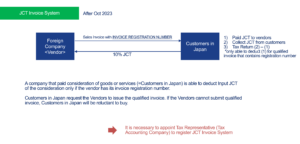
Once the Comapny-A (Seller/Supplier) obtains the JCT invoice registration number, which means this company becomes a taxable entity that is obligated to file JCT tax returns on a regular basis.
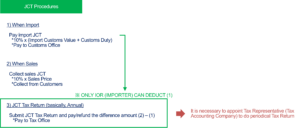
For the case of a non-resident entity (Company-A), when Company-A imports and sells to customers in Japan, following 3 steps are the standard procedure.
(1) Pay import JCT to a customs office, 10% of the import customs value when Company-A imports.
<PAY TO CUSTOMS OFFICE>
(2) Obtain JCT from a customer in Japan, 10% of the sales price when Company-A sells
(3) Submit JCT tax return
(3-1) If you paid (1) as IOR = Importer, which means you appoint ACP, then you’re required to pay only the difference amount (2) – (1)
(3-2) If you paid (1) but you were not IOR = Importer, then you’re required to pay all the amount of (2). You can’t deduct (1).
Please be careful that only the IMPORTER can deduct the input JCT (import consumption tax) at the time of tax filing mentioned above (3). In other words, if another IOR service provider became the IMPORTER when you import, basically it would not be possible for the non-resident entity to deduct the input JCT (import consumption tax). Therefore, you have to pay all the amount of (2) to a tax office (mentioned above (3-2).
On the other hand, by importing with ACP and becoming the IMPORTER, you can deduct the input JCT (import consumption tax) when filing JCT tax returns as mentioned above (3). Therefore, you would only need to pay the difference amount (2) - (1) to a tax office (as mentioned above (3-1).
This is one of the significant advantages of using the ACP service instead of the IOR service.
For this reason, we strongly recommend using ACP so that you can become IOR.
References
Japan Customs - Customs Valuation System in Japan
Amazon, in seller central website, released the guideline of Customs Valuation.
Main Trade Procedures and Customs Valuation (English)
Main Trade Procedures and Customs Valuation (Chinese)
Main Trade Procedures and Customs Valuation (Japanese)
-----
For more basic information (Illustrated and Video)
ACP insights
ACP insight 1-Customs Valuation
ACP insight 5-ACP Qualification
ACP insight 6-What kind of cases require for ACP?
ACP insight 9-ACP Import under VMI - Vendor Managed Inventory
ACP Service for Importer of Record (IOR)
ACP Service for Exporter of Record (EOR)
IOR Service for Food Tools, Kitchen Tools, Tumblers, Cutlery
Tax Representative Service (Consumption Tax)